
Additive manufacturing encompasses distinct mechanical processes, each transforming digital CAD models into physical matter through entirely different physics. While marketing materials frequently treat 3D printing as a single unified concept, choosing the wrong process for your project leads to failed assemblies, snapped brackets, or excessive production costs.
In modern workshop environments, three core technologies dominate additive fabrication: Fused Deposition Modeling (FDM), Stereolithography (SLA/MSLA), and Selective Laser Sintering (SLS).
To help makers, engineers, and workshop technicians select the ideal process, we benchmark each technology across mechanical bonding physics, dimensional tolerances, workflow ergonomics, and long-term operating costs.
Technical Architecture Comparison
Before examining the laboratory strengths of each process, examine the mechanical fundamentals:
| Parameter | FDM / FFF (Extrusion) | SLA / MSLA (Resin Vat) | SLS (Powder Sintering) |
|---|---|---|---|
| Raw Material Form | 1.75mm solid thermoplastic spool | Liquid UV photopolymer resin | Fine polymer powder (Nylon PA11/PA12) |
| Forming Mechanism | Thermal melting through heated brass/hardened nozzle | Photopolymerization via 405nm UV light source | Laser sintering via CO2 or fiber laser |
| Minimum Layer Height | 50 to 300 microns (0.05 - 0.30 mm) | 20 to 100 microns (0.02 - 0.10 mm) | 80 to 120 microns (0.08 - 0.12 mm) |
| XY Dimensional Tolerance | ±0.15% (lower bound ±0.2 mm) | ±0.50% (lower bound ±0.05 mm) | ±0.30% (lower bound ±0.2 mm) |
| Mechanical Isotropy | Anisotropic (weak Z-axis layer adhesion) | Isotropic (fully cross-linked polymer matrix) | Isotropic (homogeneous powder fusion) |
| Support Requirements | Required (support interface lines on overhangs) | Required (micro-supports leave contact pips) | Self-supporting (unsintered powder bed) |
| Post-Processing Burden | Minimal (peel supports, deburr brim) | High (IPA bath wash, UV cure oven, gloves) | Moderate (de-powdering, bead blasting) |
| Typical Hardware Cost | $200 to $1,500 (Desktop CoreXY) | $200 to $3,500 (Desktop MSLA) | $5,000 to $30,000+ (Benchtop SLS) |
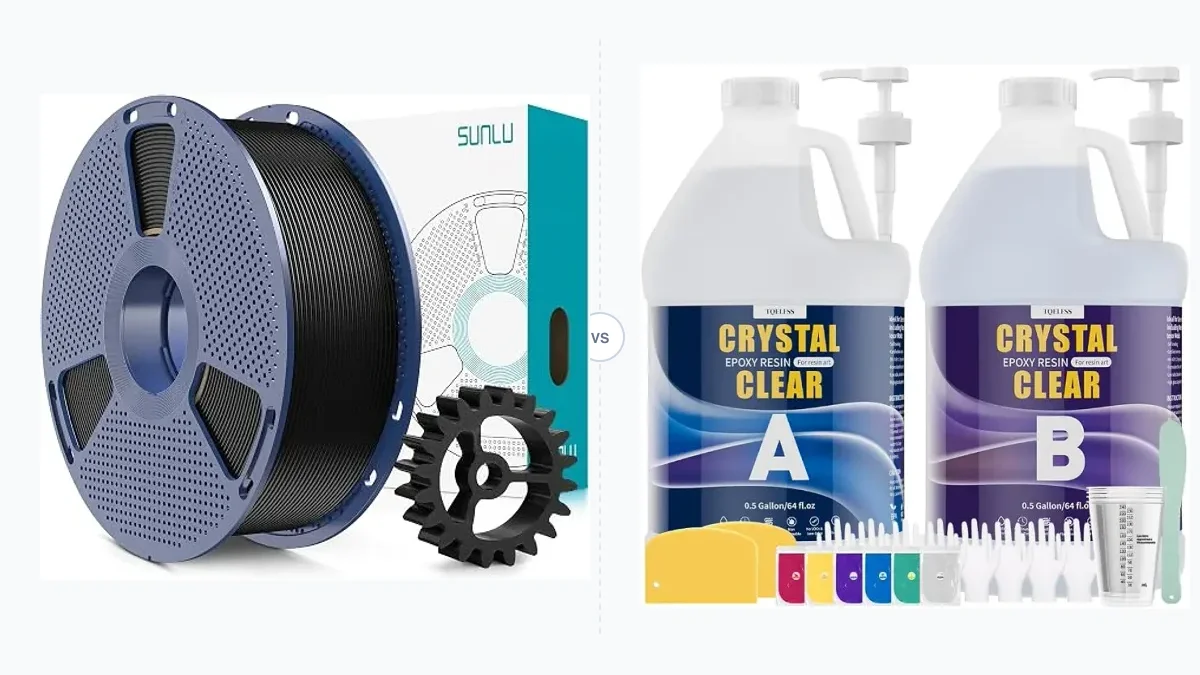
1. Fused Deposition Modeling (FDM / FFF)
The Extrusion Mechanism
Fused Deposition Modeling feeds a continuous spool of thermoplastic filament into a direct-drive or Bowden extruder. A drive gear pushes the 1.75mm strand into a hotend melt zone heated between 190°C and 300°C. Molten plastic is extruded through a calibrated orifice (typically 0.4mm) and deposited along programmed toolpaths onto a heated build plate.
Modern enclosed CoreXY platforms, such as the Bambu Lab P1S and QIDI Q1 Pro, execute toolhead accelerations up to 20,000 mm/s² and linear speeds up to 500 mm/s while maintaining tight volumetric control.
Mechanical Strengths & Physics
- Broad Material Versatility: FDM supports standard biodegradable PLA, impact-resistant PETG, weather-proof ASA, flexible TPU 95A, and abrasive carbon-fiber-reinforced Nylons (PA-CF).
- Large Build Volumes: Desktop FDM frames regularly deliver 220mm³ to 350mm³ cubic build volumes, making them the primary solution for cosplay helmets, automotive ducting, and industrial jigs.
- Low Operating Cost: Standard filament costs between $15 and $22 per kilogram, with zero recurring chemical consumables.
Limitations in the Workshop
- Mechanical Anisotropy: Because plastic strands cool before adjacent layers are laid down, interlaminar bond strength is lower than tensile strength within the XY plane. Under tension parallel to the Z-axis, FDM parts can delaminate at 40 to 60 percent of their XY yield point.
- Visible Layer Grooves: Even at 0.12mm layer heights, cylindrical overhangs and shallow domes display visible stepping artifacts that require manual sanding or filler primer.
2. Stereolithography & MSLA (Resin Photopolymerization)
The Photopolymerization Mechanism
Stereolithography replaces heated extrusion nozzles with light-activated chemical photopolymerization. A liquid photopolymer resin tank features a transparent fluoropolymer (FEP or PFA) bottom film. An array of 405nm ultraviolet LEDs projects cross-sectional slice patterns (via a monochrome LCD screen or galvo-steered laser) into the resin.
Each exposed layer solidifies in 1.5 to 3.5 seconds. The build platform lifts or tilts away from the film, allowing fresh liquid to fill the gap, as demonstrated on high-speed tilt machines like the ELEGOO Saturn 4 Ultra.
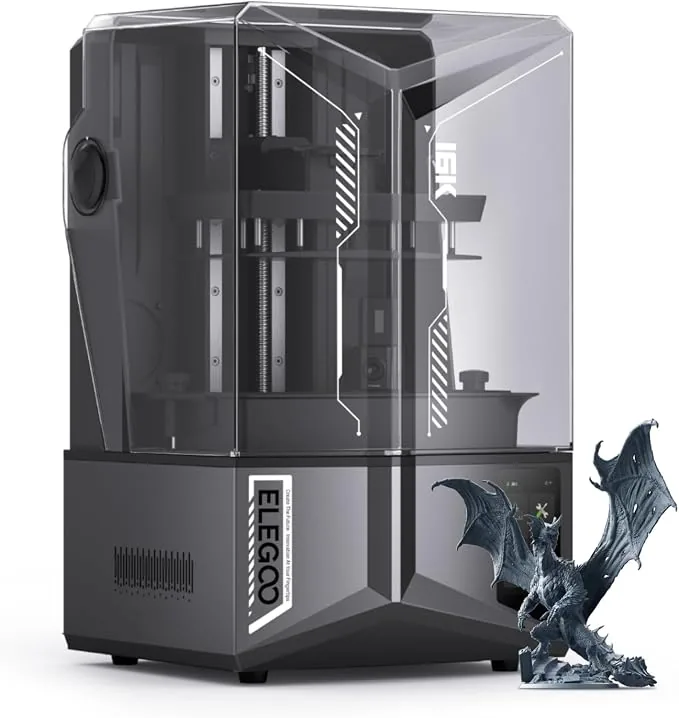
Optical Resolution & Isotropic Integrity
- Microscopic Surface Fidelity: With 12K and 14K monochrome LCDs delivering XY pixel pitches of 16 to 24 microns, resin printing replicates skin textures, miniature chainmail, sharp jewelry prongs, and dental dies with zero visible stepping.
- Truly Isotropic Solidification: Photopolymers form covalent cross-links across layer boundaries during UV curing. Resin parts behave identically regardless of load direction, producing airtight and watertight enclosures.
Workflow & Environmental Considerations
- Chemical Safety Protocol: Uncured liquid resin contains reactive monomers that cause skin sensitization and respiratory irritation. Technicians must maintain nitrile gloves, safety goggles, and dedicated ventilation.
- Two-Stage Finishing: Parts must be washed in 99% isopropyl alcohol (IPA) to strip unreacted surface resin and then baked in a 405nm ultraviolet curing chamber for 5 to 15 minutes to reach final Shore D hardness. For step-by-step procedures, consult our guide on How to Wash and Cure Resin Prints Safely.
3. Selective Laser Sintering (SLS)
The Powder Sintering Mechanism
Selective Laser Sintering operates within a heated nitrogen or atmospheric chamber containing fine thermoplastic powder, predominantly Nylon 12 (PA12) or Nylon 11 (PA11).
A recoater blade spreads an ultra-thin layer of powder (typically 100 microns) across the build bed. The chamber pre-heats the powder just below its polymer melting point. A high-power laser traces the slice profile, raising the temperature by a fraction of a degree to fuse the powder particles without fully liquidifying them. Once the layer fuses, the build platform lowers by 0.1mm, a new powder layer spreads, and the cycle repeats.
Industrial Advantages
- Complete Freedom of Geometry: Because unsintered powder surrounds and physically supports every part throughout the build envelope, SLS requires zero support structures. Designers can produce complex internal fluid manifolds, gyroid heat exchangers, and pre-assembled articulated joints in a single print run.
- Massive Batch Nesting: Operators can stack parts three-dimensionally throughout the entire vertical volume (3D nesting), maximizing throughput for small-batch manufacturing.
- Engineering-Grade Thermoplastics: Finished PA12 parts exhibit genuine industrial durability, high impact resistance, chemical stability, and heat deflection ratings exceeding 140°C.
The Benchtop Bottleneck
- Equipment and Facility Cost: Even benchtop SLS units (such as the Sinterit Lisa or Formlabs Fuse series) range from $5,000 to $25,000, excluding powder recovery stations, industrial vacuum filtration, and media blasters.
- Powder Handling & Refresh Rates: De-powdering requires compressed air cabinets and particulate respirators. Unused powder experiences thermal aging and must be blended with 30 to 50 percent virgin powder before each build.
Process Decision Framework: Which Technology Should You Choose?
                                [ What Are You Making? ]
                                            │
               ┌────────────────────────────┼───────────────────────────┐
               ▼                            ▼                           ▼
      [ Functional Jigs,            [ Miniatures, Figures,      [ End-Use Production,
      Large Enclosures, &           Dental Models, &            Complex Assemblies, &
       Prototyping ]                High-Detail Art ]           No-Support Manifolds ]
               │                            │                           │
               ▼                            ▼                           ▼
        Select **FDM**              Select **SLA / MSLA**         Select **SLS**
     (Bambu P1S / QIDI Q1)        (ELEGOO Saturn 4 Ultra)     (Benchtop / Service Bureau)
Choose FDM If:
- You build functional brackets, workshop organizers, robotic linkages, or cosplay armor exceeding 200mm in size.
- You want rapid plug-and-play operation with dry filament storage, using tools like the Creality Space Pi or SUNLU S2 dryer.
- You need budget-friendly consumable costs ($18/kg) without chemical wash stations.
Choose SLA/MSLA If:
- You print 28mm to 75mm tabletop gaming miniatures, figurines, scale models, or jewelry patterns.
- Your application demands smooth injection-molded surface aesthetics out of the box.
- You require tight dimensional tolerances for fluid-tight caps, o-ring grooves, or snap-fit electronic enclosures.
Choose SLS If:
- You produce low-volume commercial production runs (50 to 500 units) without tooling expenses.
- Your components contain impossible undercut geometry or integrated hollow channels that cannot accommodate support removal.
- You require end-use Nylon PA12 structural integrity with complete three-dimensional isotropy.
Featured Workshop Hardware
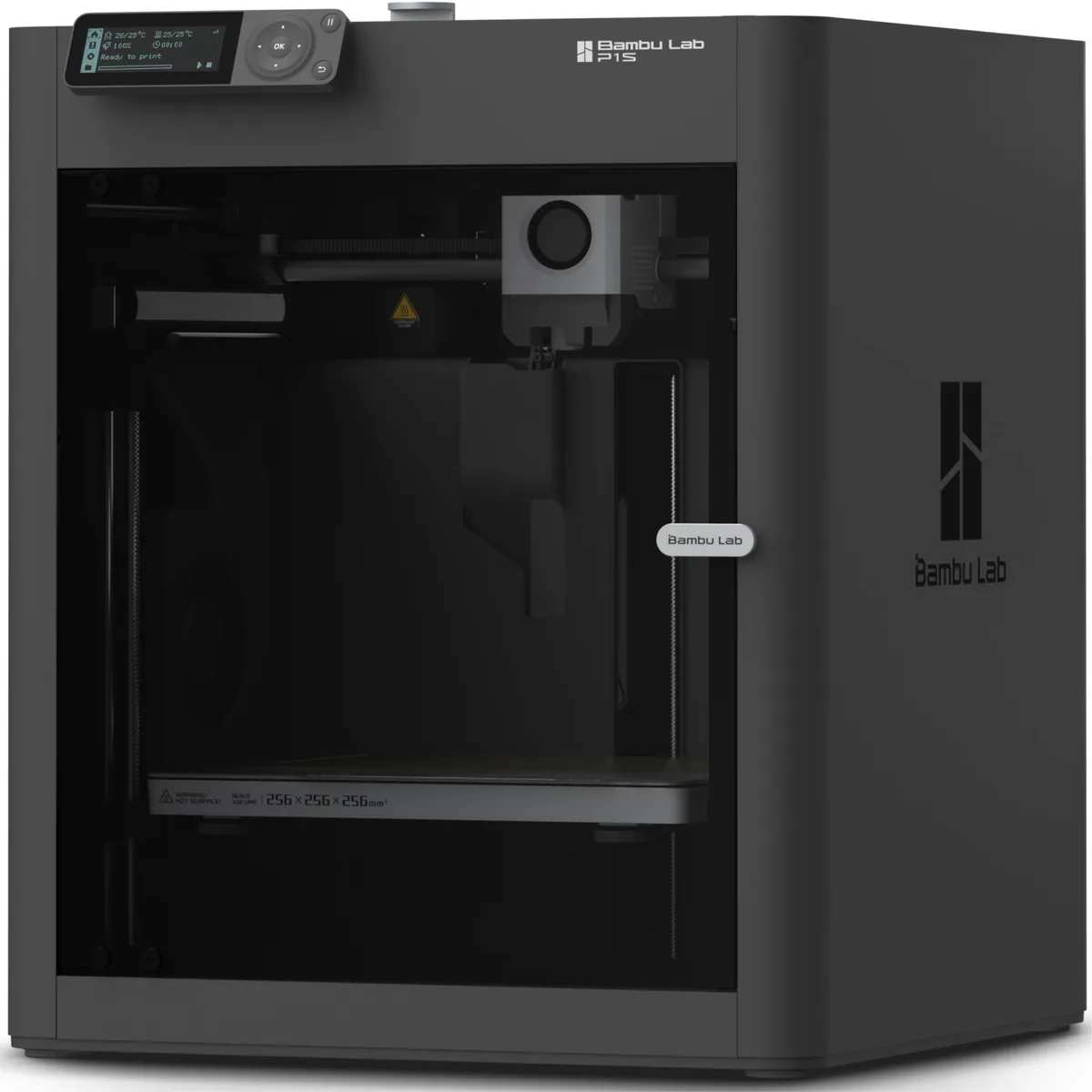
Bambu Lab P1S Enclosed High-Speed 3D Printer
Pros
- Robust enclosed CoreXY chassis delivers reliable high-speed prints with PLA, PETG, and ABS
- Automated vibration resonance compensation and pressure advance ensure crisp sharp corners
- Plug-and-play ecosystem with multi-color AMS material management
Cons
- Passively heated enclosure requires pre-heating bed for high-shrinkage ABS
- Proprietary hotend assembly
Summary Verdict
No single 3D printing technology serves every additive manufacturing use case. FDM remains the undisputed champion of cost, build size, and workshop versatility for everyday makers. SLA/MSLA stands as the benchmark for micron-level optical detailing and watertight isotropic parts. SLS represents the industrial pinnacle of geometry freedom and end-use structural nylon production. Understanding these differences is crucial when choosing your first 3D printer. You can also explore specific components in our Direct Drive vs Bowden: A Technical Guide. Find more detailed comparisons in our 3D printing how-to guides.