

The best multi-spool filament dryer for a print farm is the model whose spool capacity, temperature range, airflow, feed ports, and timer match the materials and number of printers in the workflow. The sections below explain the production case, compare four dryer designs, place their listed specifications side by side, and finish with a use-case decision.
Wet filament can produce popping, stringing, surface defects, and weak interlayer bonds. Those faults become expensive when multiple printers share material inventory and delivery schedules. A multi-spool dryer supports batch preparation and direct feeding, but the correct device still depends on the filament maker’s drying temperature and the farm’s actual spool throughput.
Why Your Print Farm Needs a Multi-Spool Dryer
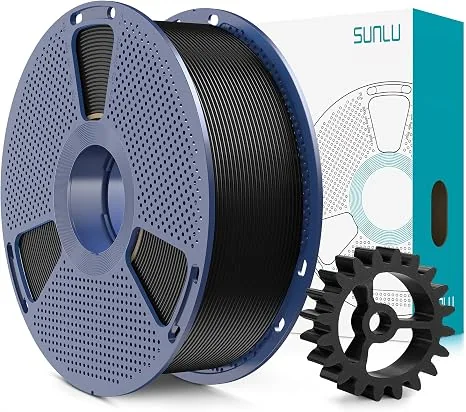
A multi-spool dryer reduces material-handling bottlenecks by preparing several rolls together and, on supported models, feeding more than one printer from a controlled enclosure.
Batch Processing and Workflow Efficiency
The most obvious benefit is throughput. You can dehydrate an entire project’s worth of material in one go. While four spools of black PETG are drying for a customer order, you can be printing with the previously dried batch of white PLA. This continuous cycle minimizes printer downtime. You’re no longer waiting hours for a single spool to dry before starting a critical 24-hour print.
Uncompromising Material Consistency
Print farms depend on repeatable material condition. If printers pull from spools with different moisture histories, dimensional accuracy, surface finish, and mechanical properties can vary. A centralized drying process reduces that variable when operators still track material lot, drying cycle, storage time, and printer profile. Related material guidance appears under filaments and resins.
Active Drying During Long Prints
Multi-spool dryers with output ports can feed filament directly while the enclosure remains heated. Direct feeding reduces the time that Nylon, PC, or moisture-sensitive TPU spends in room air during a long job, although it does not prove that the filament stays at one moisture level from first layer to last. Reviewing the key factors in choosing a filament dryer helps you match these operational constraints to the right hardware.
The Top 4 Multi-Spool Dryer Contenders
The four contenders differ in manufacturer-listed capacity, heating method, maximum temperature, air circulation, output ports, dimensions, and controls.
1. SUNLU S4 Pro
The SUNLU S4 is all about capacity. It’s a beast designed to dry a ton of filament at once. It comfortably holds four 1kg spools (or two 3kg spools if you remove the center divider), making it the go-to for batch-prepping materials for your entire print farm.
SUNLU lists three heating zones, including side PTC heaters and a bottom heating pad, plus three circulation fans. The controls provide material presets and custom temperature and time profiles up to the manufacturer’s listed 70°C maximum.
It includes eight filament outlets for feeding multiple printers or a multi-material unit. Feed reliability still depends on spool width, roller alignment, tube bends, outlet selection, and the pull force of the receiving extruder.
Verdict: The top choice for maximum throughput. If your main goal is to dry as many spools as possible in one cycle, the S4 is your machine.
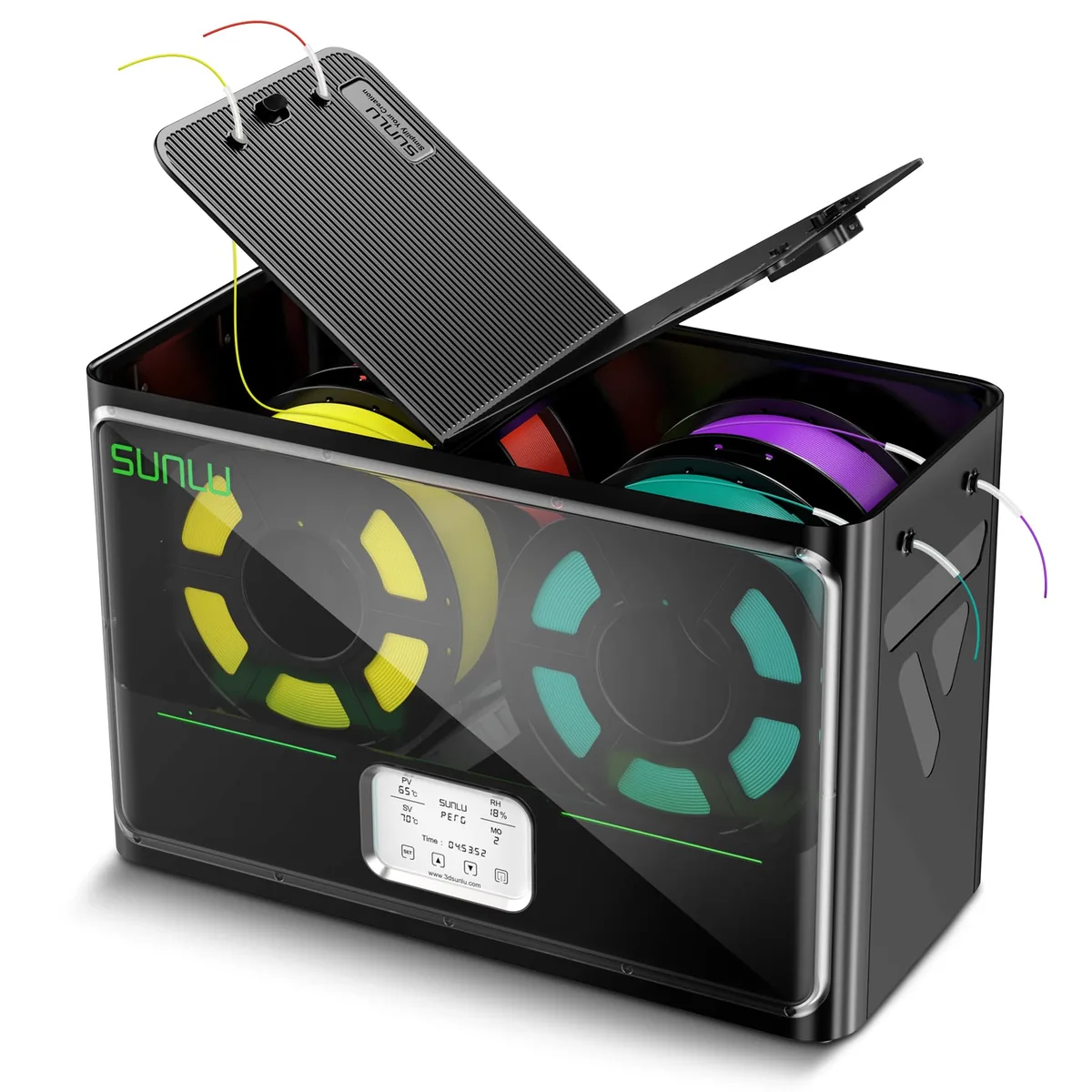
SUNLU S4 Pro 4-Spool Filament Dryer & Drybox
Pros
- Massive 4-spool capacity dries 4 rolls simultaneously for Bambu Lab AMS or multi-printer setups, 350W rapid PTC heating with three high-flow circulation fans, 8 dedicated filament feed ports with PTFE tubing for direct printing from drybox, Automated humidity maintain mode re-triggers heating when ambient humidity exceeds threshold
- Eight filament outlets for maximum feed flexibility.
- Strong and even heating performance.
Cons
- Higher upfront cost (~$149)
- Requires dedicated 515 x 267 x 268 mm desktop shelf space
2. Creality Space Pi Plus
Creality’s new dryer lineup is impressive, and the Space Pi Plus is a standout. While the SUNLU S4 is about raw capacity, the Space Pi Plus focuses on heating efficiency and smart design. It uses a single, powerful 110W PTC heating element that wraps around the chamber for true 360° airflow.
Its listed capacity is two standard 1 kg spools on dual rollers. Creality lists a maximum temperature of 65°C, so the Space Pi Plus covers many PLA, PETG, TPU, ABS, and ASA drying profiles but may require longer cycles or a hotter rated dryer for some Nylon and Polycarbonate grades.
The user interface is a 4-inch touchscreen, a nice upgrade from the button-based UIs on older models. It has 12 built-in filament profiles and one-touch settings. For those running a professional 3D printing business, this kind of user-friendly operation saves time.
Verdict: The best all-rounder with modern features. It offers great heating performance, a flexible capacity, and a polished user experience.
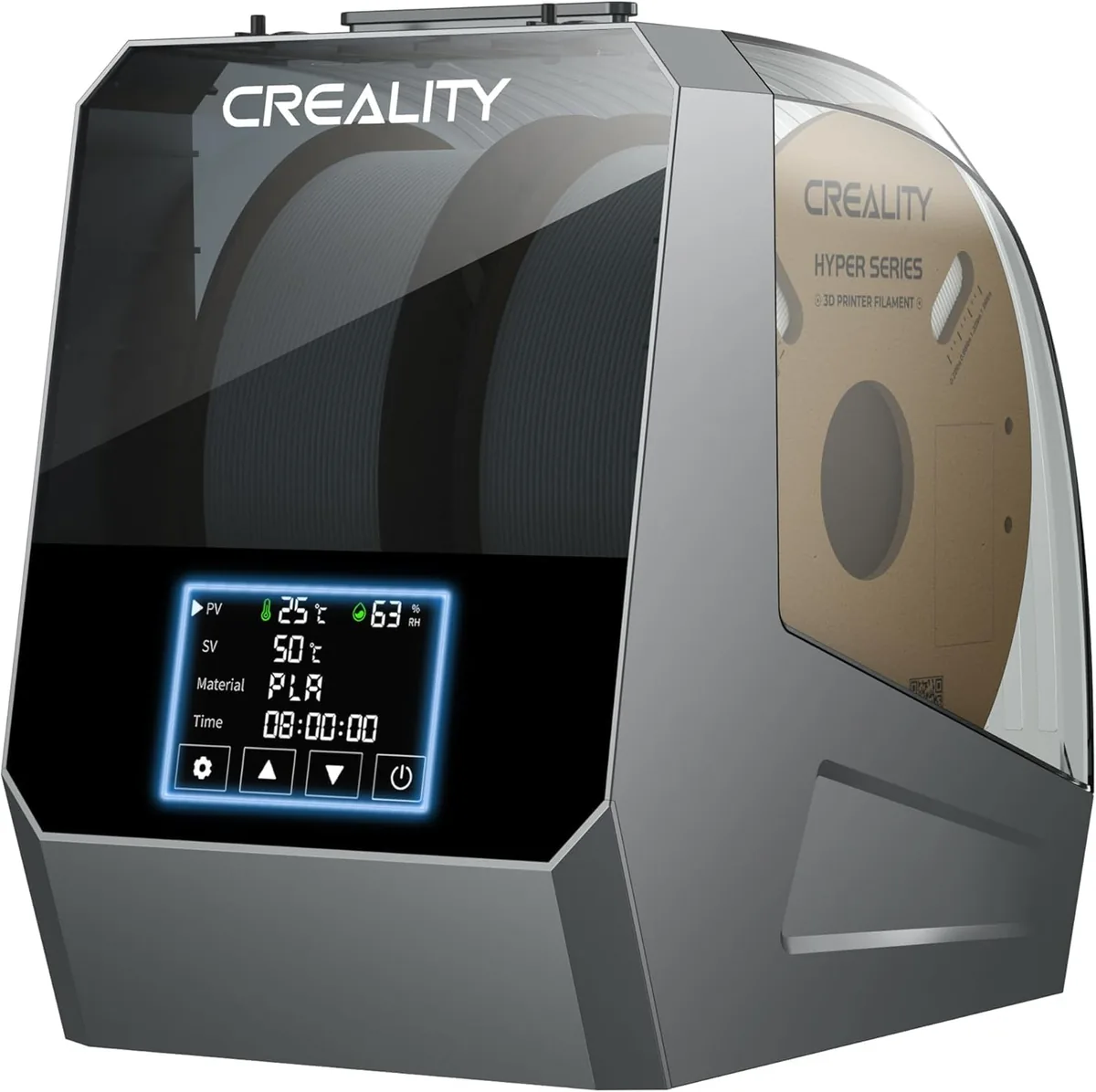
Creality Space Pi Plus Dual-Spool Filament Dryer
Pros
- 160W double PTC heating system warms two 1kg spools simultaneously, Independent roller bearings allow smooth feeding for two separate extruders or AMS Lite, Real-time dual humidity monitoring with automated timer shutoff, Accommodates both 1.75mm and 2.85mm spools
- Large touchscreen UI is intuitive and easy to use.
- Flexible capacity for 2 or 4 spools.
Cons
- Takes up larger workbench footprint (approx. 315 x 240 x 300 mm)
- Weighs 2.2kg empty
3. EIBOS Polyphemus
The EIBOS Polyphemus is another high-capacity contender that directly competes with the SUNLU S4. It also holds four 1kg spools and is designed to act as a central drying hub. Its heating mechanism is slightly different; it uses a 110W PTC heater positioned at the bottom, with a fan that blows air upwards through the center of the spools.
The bottom-heater and upward-airflow layout places the heat source below the spools. Temperature distribution depends on spool placement, winding density, fan flow, and warm-up time. The listed 65°C maximum covers many common material profiles but may fall below the drying setting listed for some Polycarbonate grades.
The build is solid, and the clear door provides a great view of all four spools. Like the S4, it has multiple filament ports for feeding printers directly. It’s a reliable workhorse that does its job without fuss.
Verdict: A strong high-capacity alternative to the SUNLU S4. A great choice for users who primarily print with PLA, PETG, and ABS and need to dry in large batches.
4. EIBOS Cyclopes
The Cyclopes is the smaller sibling to the Polyphemus, designed to hold two 1kg spools. We include it here because it occupies a valuable middle ground. It’s perfect for smaller print farms (2-4 printers) or as a dedicated secondary dryer for specialized materials. You could have one Cyclopes dedicated to drying PA-CF and TPU while your larger S4 or Polyphemus handles the commodity PLA and PETG.
It uses a bottom-mounted PTC heater and fan, with a listed maximum temperature of 65°C. Adjustable rollers accommodate different spool widths. Actual temperature distribution depends on spool placement and airflow, so the specification does not establish an independent uniformity result.
Verdict: The perfect choice for smaller farms or for adding specialized drying capacity to an existing setup. It’s compact, efficient, and well-built.
Filament Drying, Storage, Shelf Life and Disposal Guide
Active heating is only one part of a complete material management strategy. Establishing protocols for Filament Drying, Storage, Shelf Life and Disposal Guide ensures your freshly dehydrated spools remain print-ready during long production cycles.
Head-to-Head Comparison
| Feature | SUNLU S4 Pro | Creality Space Pi Plus | EIBOS Polyphemus | EIBOS Cyclopes |
|---|---|---|---|---|
| Spool Capacity (1kg) | 4 | 2 (with rollers), 4 (without) | 4 | 2 |
| Heating Tech | Triple Heater (PTC/PI) | 110W PTC 360° | 110W PTC | 110W PTC |
| Max Temperature | 70°C | 65°C | 65°C | 65°C |
| Air Circulation | 3 Fans | 360° Vortex Fan | Central Updraft Fan | Central Updraft Fan |
| Print-From-Dryer Ports | 8 | 2 | 4 | 2 |
| Best For | Max Throughput | Modern Features | High Capacity | Compact / Specialty |
| ASIN | B0CQJMV71Z | B0DCST26Y3 | B0B81YKL3B | B0B1V4G4XW |
Which Multi-Spool Dryer Is Right For You?
The right multi-spool dryer follows from required batch capacity, filament-maker temperature limits, direct-feed count, bench space, and control preferences.
- If you need maximum batch capacity above all else: Your choice is between the SUNLU S4 Pro and the EIBOS Polyphemus. The SUNLU S4’s triple-heater design and 70°C max temp give it a slight edge for drying a wider range of materials at speed.
- If you value a two-spool design and touchscreen controls: The Creality Space Pi Plus provides 360° PTC air circulation, dual rollers, and a 65°C manufacturer-listed maximum.
- If you’re starting a smaller farm or need a dedicated dryer for exotics: The EIBOS Cyclopes is the perfect fit. It provides professional-grade drying for two spools without the massive footprint or cost of its larger counterparts.
A print farm should choose a dryer from verified spool capacity, material temperature, feed-port count, airflow design, and available space. The SUNLU S4 Pro favors four-spool throughput and a 70°C ceiling; the Space Pi Plus favors two-spool handling and modern controls; the EIBOS models fill four-spool and compact two-spool roles. You can compare other Filament Dryers processing to optimize your workflow.