
Filament and resin stay usable longer when moisture, temperature, light, contamination, shelf life, and disposal are controlled according to the material maker’s instructions. The sections below identify degradation signs, explain active filament drying, cover long-term storage, and finish with shelf-life and disposal rules in that order.
Many FDM filaments are hygroscopic, which means they absorb moisture from ambient air. MSLA resins have finite shelf lives and remain sensitive to temperature, UV exposure, and contamination. Material faults can resemble printer or slicer faults, so diagnosis should begin with observable extrusion, surface, and curing symptoms.
Recognizing Material Degradation: The Telltale Signs
Material degradation appears as audible, visual, mechanical, or curing symptoms that differ between FDM filament and MSLA resin.
FDM Filament (The “Wet” Spool)
When water-logged filament hits a 200°C+ hotend, the trapped water instantly flashes to steam. This violent expansion wrecks the extrusion process.
- Audible Cues: The most obvious sign is sound. Listen for a distinct crackling, popping, or hissing sound coming directly from the nozzle as the printer extrudes. That is the sound of water boiling inside your filament.
- Visual Cues: A wet spool produces prints with a terrible surface finish. Look for extreme stringing and oozing, a fuzzy or rough texture, and inconsistent layer lines. You might also see signs of under-extrusion, as the steam pockets disrupt the flow of molten plastic.
- Mechanical Failure: The final part will be incredibly brittle. The steam bubbles create voids within the plastic, leading to horrible layer adhesion. A part printed with wet filament will often snap easily along the layer lines with very little force.
MSLA Resin (Expired or Contaminated)
Resin failures are less about moisture and more about chemical breakdown or contamination.
- Visual Cues: Check the resin in the vat before printing. If you see separated pigments (swirls of color that won’t mix) or the resin has become unusually thick and gel-like, it is likely expired or has been exposed to improper temperatures.
- Print Failures: The most common symptom is a failed print with nothing on the build plate, just a flat sheet of cured resin stuck to your FEP or PFA film. You might also see small, partially cured “floaters” contaminating the vat, which can damage your film or LCD screen if not filtered out.
Active Filament Drying: The Only Real Solution
Active filament drying uses controlled heat and air circulation to remove absorbed moisture; desiccant storage is better suited to slowing moisture uptake after the spool is dry.
A dedicated filament dryer provides controlled heat and air movement for moisture-sensitive materials. The temperature limit of the filament and spool prevents the dryer from becoming a melting or fusing risk. Reviewing filament dryers compared helps you match capacity to your throughput.

Creality Space Pi Filament Dryer
Pros
- Fast, even heating with its PTC core and fan.
- Intuitive touchscreen interface.
- Great value for a single-spool solution.
Cons
- Limited to 65°C
- not hot enough for some engineering-grade materials like PC.
If you are debating between single-spool options, the Creality Space Pi vs SUNLU S2 Filament Dryer Guide outlines the heating differences.
Drying Parameters: A Practical Cheat Sheet
Filament-maker drying settings determine the safe starting temperature and duration; excessive temperature can soften the filament or fuse adjacent loops on the spool.
| Filament Type | Drying Temperature (°C) | Drying Time (Hours) | Notes |
|---|---|---|---|
| PLA / PLA+ | 45-55°C | 4-6 | Easy to over-bake. Stick to the low end. |
| PETG / CPE | 60-65°C | 2-4 | Responds very well to drying. |
| ABS / ASA | 60-65°C | 2-4 | Less hygroscopic but still benefits. |
| TPU / TPE | 50-55°C | 4-6+ | Flexible filaments are like sponges. |
| Nylon (PA) | 70-80°C | 8-12+ | Extremely hygroscopic. Requires a high-temp dryer. |
| Polycarbonate (PC) | 70-80°C | 8-12+ | Must be bone-dry for good results. |
| PVA / BVOH | 45-55°C | 10-16 | Soluble supports are the most hygroscopic materials. |
This table summarizes ranges commonly listed by filament makers. Use the exact spool or material datasheet first, and extend time rather than temperature when the maker permits a longer cycle but not a hotter one.
For workshops running multiple printers or using a lot of high-temperature materials like Nylon and Polycarbonate, a multi-spool dryer with a higher temperature range is a wise investment.
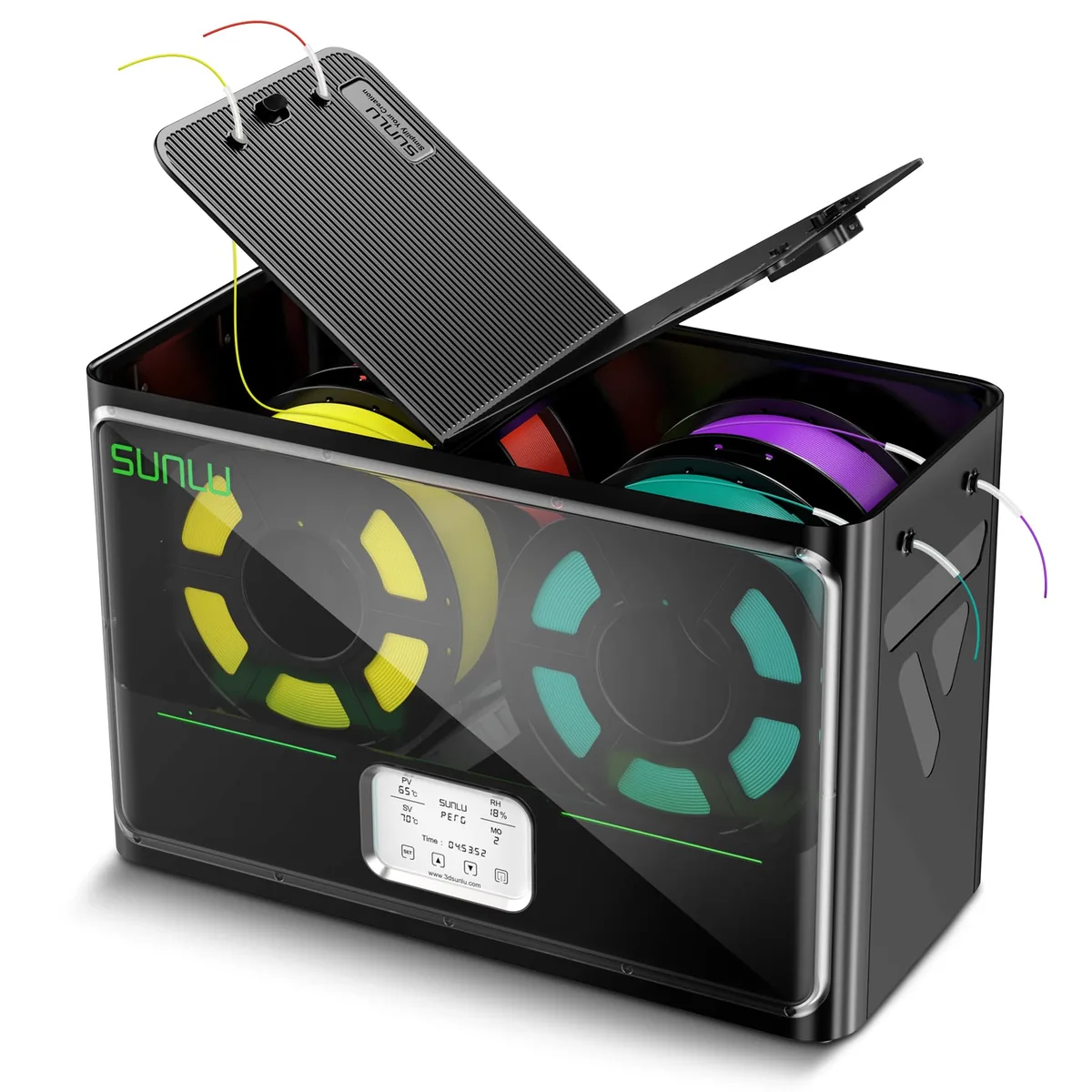
SUNLU S4 Pro 4-Spool Filament Dryer & Drybox
Pros
- Massive 4-spool capacity dries 4 rolls simultaneously for Bambu Lab AMS or multi-printer setups, 350W rapid PTC heating with three high-flow circulation fans, 8 dedicated filament feed ports with PTFE tubing for direct printing from drybox, Automated humidity maintain mode re-triggers heating when ambient humidity exceeds threshold
- Can actively feed up to four printers simultaneously.
- Excellent for drying multiple spools overnight.
Cons
- Higher upfront cost (~$149)
- Requires dedicated 515 x 267 x 268 mm desktop shelf space
Long-Term Storage: Keeping Materials Dry
Long-term storage keeps dried filament below the humidity level at which it begins to regain moisture and keeps resin away from heat, UV light, and contamination.
- FDM Filament: The best method is using vacuum-sealable bags with a few packets of rechargeable silica gel desiccant. For bulk storage, large airtight weather-sealed totes work well. Throw a pound of bulk desiccant in the bottom and add a cheap digital hygrometer. Your goal is to keep the relative humidity (RH) inside the box below 15%.
- MSLA Resin: Always store resin in its original opaque, UV-blocking bottle. Keep it in a cool, dark cabinet or box, away from direct sunlight or temperature swings. A stable room temperature (20-25°C) is ideal. Never, ever pour used resin from your vat back into the fresh bottle. This introduces contamination. If you must save it, filter it into a separate, clearly labeled “USED” bottle.
Shelf Life and Responsible Disposal
Shelf-life and disposal decisions depend on material condition, the maker’s safety data sheet, local waste rules, and whether resin remains liquid or contaminated with solvent.
Shelf Life
- Filament: For most common polymers like PLA, PETG, and ABS, the shelf life is almost indefinite if the material is kept dry and out of direct sunlight (UV radiation). PLA becoming brittle is almost always a sign of moisture absorption, not “old age.” A few hours in a dryer can often fully restore a spool that is years old.
- Resin: Resin bottles carry a manufacturer expiration date. Over time, the photoinitiators that trigger curing can lose effectiveness, which can contribute to slower cure times and failed prints. Use material within the maker’s shelf-life and storage conditions.
Safe Disposal: A Critical Responsibility
How you throw away waste is just as important as how you print.
- Failed Prints & Scraps: The hard truth is that most 3D printed waste from FDM printers is not recyclable through municipal curbside programs. PLA is technically compostable in industrial facilities, but almost no residential program accepts it. ABS, PETG, and others are typically considered #7 “Other” plastic and go straight to the landfill. The most effective “recycling” is waste reduction. Keep your machine well-maintained to prevent failed prints.
- Empty Spools: Cardboard spools can be broken down and recycled. Plastic spools are trickier; check for a recycling symbol, but do not be surprised if your local service rejects them. A better option is to find workshop uses for them, like wrapping extension cords or wire.
- Used Resin, Solvents, & Contaminated Items: This is a major safety issue.
- NEVER pour liquid resin or resin-contaminated alcohol (IPA) down the drain. It is toxic to aquatic life and can damage plumbing.
- Separate liquid waste. Keep waste resin in a labeled compatible container and follow the resin safety data sheet plus local hazardous-waste rules. Do not assume home curing changes its legal disposal category.
- Cure contaminated items when the maker and local rules direct it. Gloves, paper towels, and failed prints covered in liquid resin need controlled handling until they are no longer uncured contamination.
- Handle used IPA as flammable, resin-contaminated solvent. Keep it closed and labeled, and use an approved household hazardous-waste or solvent-recovery route instead of open evaporation near people or ignition sources.
Material handling protects print consistency when filament is dried at maker-listed settings and returned to sealed storage. Resin handling remains a chemical-waste task: keep liquid resin and contaminated solvent out of drains, follow the safety data sheet, and use the disposal route required by local rules. Upgrading your storage with dedicated Filament Dryers ensures stable production.