
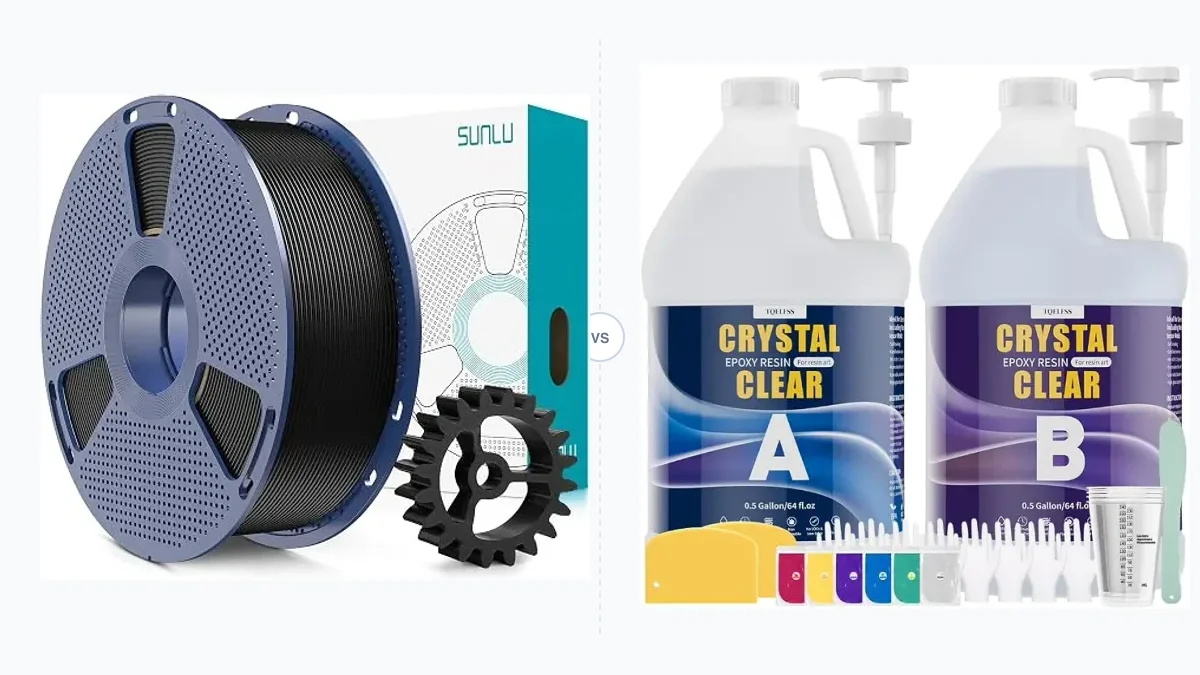
When deciding on a desktop machine, understanding resin vs filament 3D printing involves evaluating print resolution, material cost, and intended applications. You will learn the definition of resin 3D printing, the definition of filament 3D printing, and the four key differences between resin and filament 3D printers. Then, we will explore the downsides of a resin 3D printer and the downsides of a filament 3D printer before concluding whether you should get a filament or resin printer.
What is the Definition of Resin 3D Printing?
Resin 3D printing is a manufacturing process that uses a targeted ultraviolet light source to cure liquid photopolymer resin layer by layer into a solid object. The technology includes processes like Stereolithography, Digital Light Processing, and Masked SLA. A resin printer immerses a build plate into a vat of liquid resin and cures the material precisely according to a digital design. Because the curing process fuses the liquid material continuously, the resulting prints are isotropic, meaning they possess uniform strength in all directions. To evaluate how these material properties interact with hardware capabilities, see our 3D printer comparison chart. This method is highly accurate and is suited for fine models such as figurines, dental casts, and jewelry mock-ups.
ELEGOO lists the Saturn 4 Ultra 16K as a resin 3D printer featuring a 16K resolution LCD and tilt release technology. The manufacturer specifies smart tank heating that holds 30 degrees Celsius, alongside a live camera with a light for monitoring and timelapse recording.
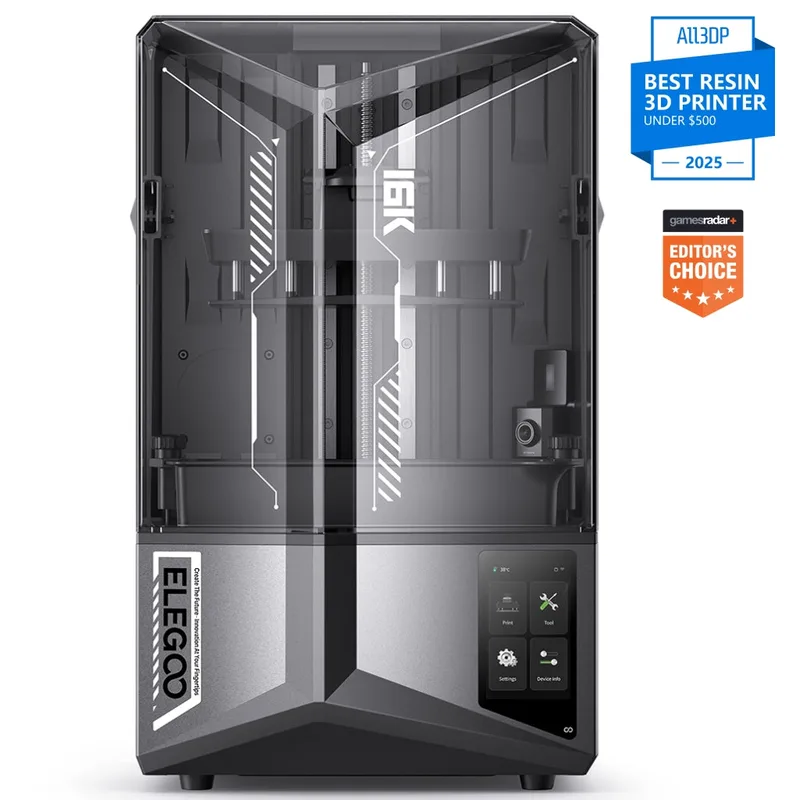
ELEGOO Saturn 4 Ultra 16K
Pros
- 16K resolution LCD
- Smart tank heating holds 30 degrees Celsius
- Live camera with light for monitoring and timelapse
Cons
- Consumables like FEP and LCD screens have limited or no warranty
What is the Definition of Filament 3D Printing?
Filament 3D printing is a manufacturing method that constructs items by melting and extruding a thermoplastic filament layer by layer. The Fused Deposition Modeling or Fused Filament Fabrication process feeds a spool of thermoplastic material, such as PLA, ABS, or PETG, into a heated nozzle. Pioneered by Scott Crump, filament printing has grown to become a dominant technology in the 3D printing arena, favored for its practicality and accessibility. The machine deposits the semi-molten plastic onto a build platform that moves along the horizontal and vertical axes. For more specific hardware breakdowns, explore our side-by-side 3D printer comparisons. This technology is widely accessible for creating usable components, home appliances, and teaching models.
Bambu Lab lists the A1 3D Printer as a full-size open-frame pick featuring a 256 by 256 by 256 millimeter build volume. The company specifies a maximum speed of 500 millimeters per second and includes an all-metal hot end with a stainless steel nozzle, plus filament tangle and run out sensors.
Bambu Lab A1 3D Printer
Pros
- All-metal hot end with stainless steel nozzle
- Filament tangle and run out sensors included
- Power loss recovery supported
Cons
- ABS and ASA filaments are not recommended
- Carbon and glass fiber reinforced polymers are not recommended
4 Key Differences Between Resin and Filament 3D Printers
The four key differences between resin and filament 3D printers are print resolution, equipment pricing, part strength, and build volume.
| Attribute | Resin 3D Printers | Filament 3D Printers |
|---|---|---|
| Print Resolution | Ultra-fine details, down to 10 microns | Visible layer lines, 100 to 400 microns |
| Material Costs | $30 to $80 per liter of resin | $15 to $30 per kilogram of filament |
| Part Strength | Isotropic but standard resins are brittle | Anisotropic but generally durable |
| Build Volume | Small, up to 192 x 120 x 200 mm | Large, starting at 220 x 220 x 250 mm |
1. Print Resolution and Detail Accuracy
Resin printers deliver exceptionally detailed models with ultra-fine layer heights down to 10 microns, according to Raise3D. This precision allows resin machines to produce smooth surfaces that often require minimal post-processing, making them ideal for applications where fine detail is paramount. In contrast, filament 3D printers commonly operate with layer thicknesses ranging from 100 to 400 microns, according to Raise3D. This results in more visible layer lines on the surface of the print, particularly on rounded items. While filament printers are quickly gaining ground in print quality, they fall behind resin printers in terms of minute detail and the smooth finish required for tabletop miniatures.
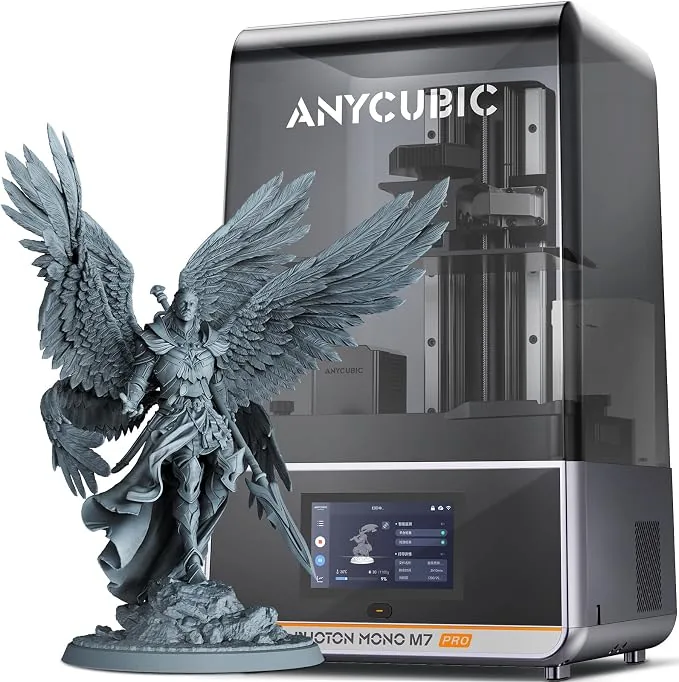
Anycubic Photon Mono M7 Pro 14K Resin 3D Printer
Pros
- Industry-first 14K mono LCD delivers unmatched 16.8x24.8 micron XY precision
- Dynamic peristaltic resin auto-fill and auto-recycle system eliminates mid-print running out
- Built-in vat heating element maintains optimal 25°C viscosity in cold workshops
- Advanced LightTurbo 3.0 COB optical system ensures uniform 90%+ UV exposure
Cons
- Higher initial price point for hobbyists
- Anycubic slicer ecosystem requires familiarity
2. Equipment Pricing and Material Costs
Filament 3D printing is typically more cost-effective because thermoplastics cost between $15 and $30 per kilogram, according to Raise3D. A good Fused Deposition Modeling printer is less expensive to acquire in the initial purchase, and the filament has a longer shelf life compared to most liquid materials. Resin is generally more expensive than filament, costing between $30 and $80 per liter, according to Raise3D. Resin printing incurs extra costs for isopropyl alcohol, safety gloves, and ultraviolet curing racks required for post-processing.
Creality lists the Ender 3 V3 SE 3D Printer as a budget pick for beginners that provides an incredible sub-$200 value. The manufacturer specifies hands-free auto bed leveling, a reliable Sprite direct drive extruder that handles PLA, PETG, and TPU, and dual Z-axis lead screws to ensure high stability.
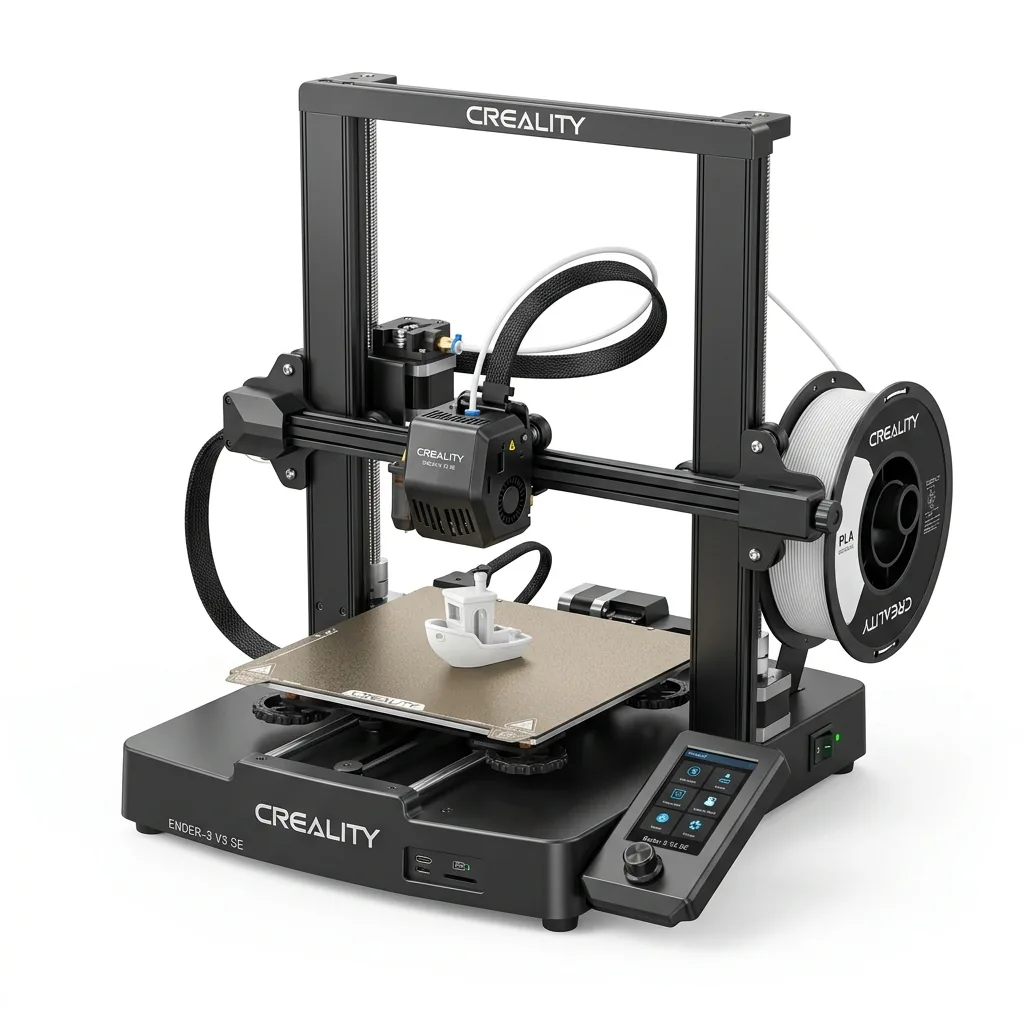
Creality Ender 3 V3 SE 3D Printer
Pros
- Hands-free auto bed leveling and Z-offset calibration
- Reliable Sprite direct drive extruder handles PLA, PETG, and TPU
- Dual Z-axis lead screws ensure high stability
- Incredible sub-$200 value
Cons
- Bowden PTFE inside hotend limits temperature to 250°C
- Open frame not ideal for ABS
3. Part Strength and Structural Durability
Filament prints are durable and functional, capable of being used as end-use parts, while standard resins tend to be brittle and may degrade over time. Filament printing produces parts with anisotropic properties, meaning the strength of the printed objects can vary depending on the direction of the layers. Filament prints are typically stronger along the horizontal axes but weaker vertically where the layers come together. Conversely, resin prints typically have isotropic properties with uniform strength in all directions due to the nature of the ultraviolet curing process. However, conventional resins remain brittle, and engineering-grade resins that withstand mechanical loads can be expensive.
4. Build Volume and Print Size Capacity
Filament 3D printers offer significantly larger build volumes, with common build sizes starting from 220 x 220 x 250 mm, according to Raise3D. This expansive capacity makes filament printers suitable for creating big models such as cosplay accessories, furniture parts, and functional mechanical components. Resin 3D printers typically provide smaller build volumes, often ranging from 130 x 80 x 160 mm to 192 x 120 x 200 mm, according to Raise3D. If you plan to print these advanced functional parts in a larger build volume, review our Bambu Lab P1S vs QIDI Q1 Pro: Which Enclosed CoreXY Wins? to find the right heated chamber machine. While the smaller dimensions of resin printers limit the maximum size of individual prints, they excel at producing multiple small, detailed items simultaneously.
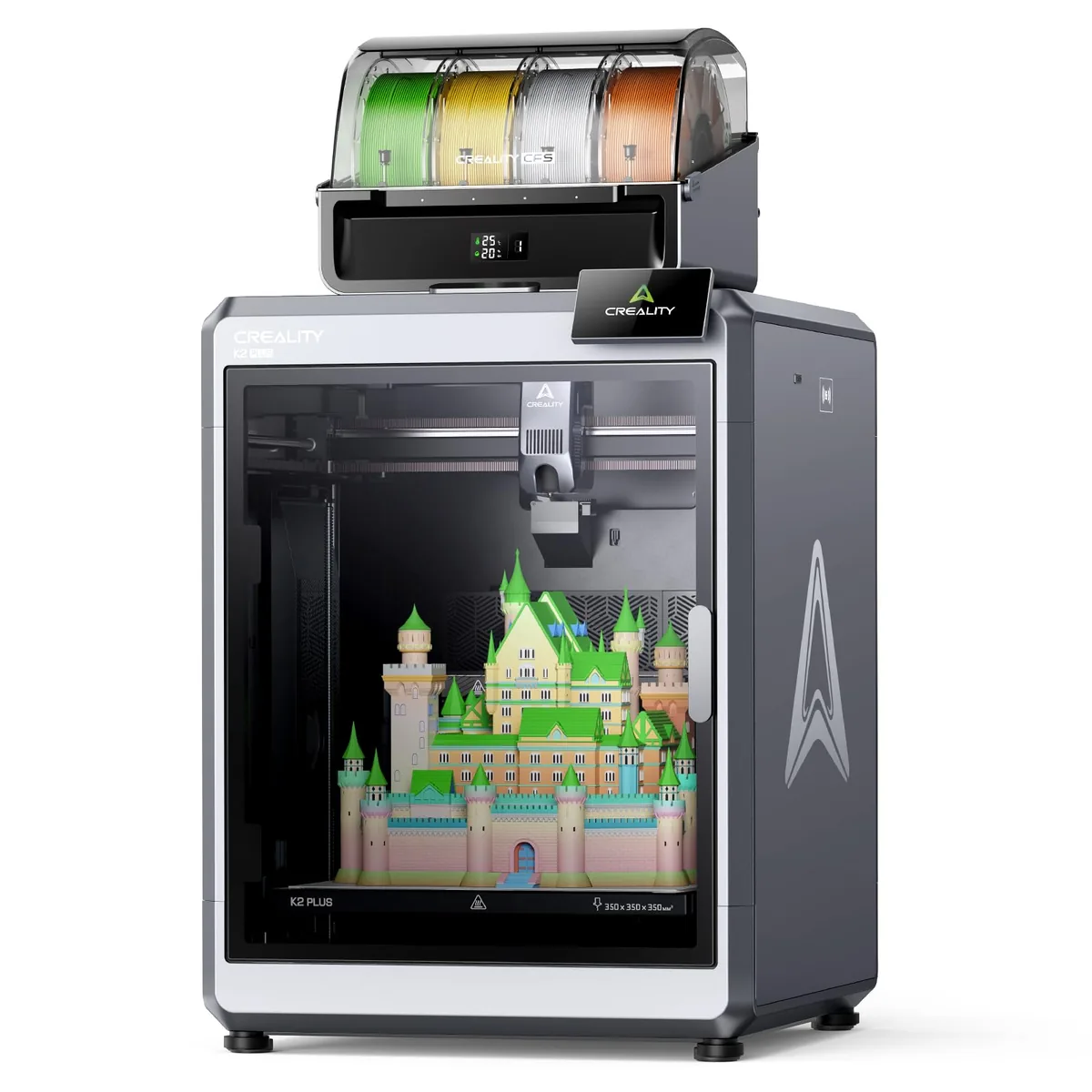
Creality K2 Plus Combo 3D Printer with CFS
Pros
- Massive 350x350x350mm build envelope easily fits full-scale functional prototypes and automotive parts
- Built-in 60°C active chamber heating and 350°C hardened hotend
- Creality Filament System (CFS) supports up to 16-color / multi-material printing
- Heavy-duty die-cast aluminum frame with FOC closed-loop servo motors
Cons
- Substantial benchtop footprint (demands sturdy dedicated table space)
- Premium price point
What are the Downsides of a Resin 3D Printer?
The downsides of a resin 3D printer include safety concerns regarding toxic liquid resin, higher material costs, mandatory post-processing, and brittle material properties. The liquid resins are poisonous when touched or inhaled without proper protection, necessitating careful handling, gloves, and adequate ventilation in the printing environment. Printed objects must be washed with solvents like isopropyl alcohol to remove uncured material, followed by further curing under an ultraviolet light source to achieve their final hardened form. According to Raise3D, standard resins tend to be brittle and may degrade over time if exposed continuously to ultraviolet light.
What are the Downsides of a Filament 3D Printer?
The downsides of a filament 3D printer include lower print resolution with visible layer lines, calibration requirements, anisotropic part strength, and potential ventilation needs. Because filament machines extrude melted plastic in layer thicknesses of 100 to 400 microns, according to Raise3D, the surfaces often display obvious layer lines. Achieving a smooth finish on filament prints typically requires additional post-processing such as sanding or chemical smoothing. Filament printers also demand proper setup and regular calibration to avoid printing flaws such as warping, stringing, gaps, and holes. Certain materials like ABS and nylon release fumes during the melting process, which requires adequate ventilation or an air filtration system to ensure a safe workspace.
Is a Resin 3D Printer Better Than Filament?
A resin 3D printer is better than filament for detailed designs, tabletop miniatures, and dental prototypes, while a filament 3D printer is better for functional parts, household repairs, and large-scale models. If you prioritize smooth surface texture and clean, sharp edges without visible layer lines, resin technology delivers the highest resolution. However, if you prefer a low-maintenance machine with minimal post-processing cleanup and safe operation for a home or school setting, a filament printer is the smarter choice. Both technologies serve different manufacturing goals, and the optimal choice depends entirely on your specific project requirements, workspace ventilation, and budget constraints.