
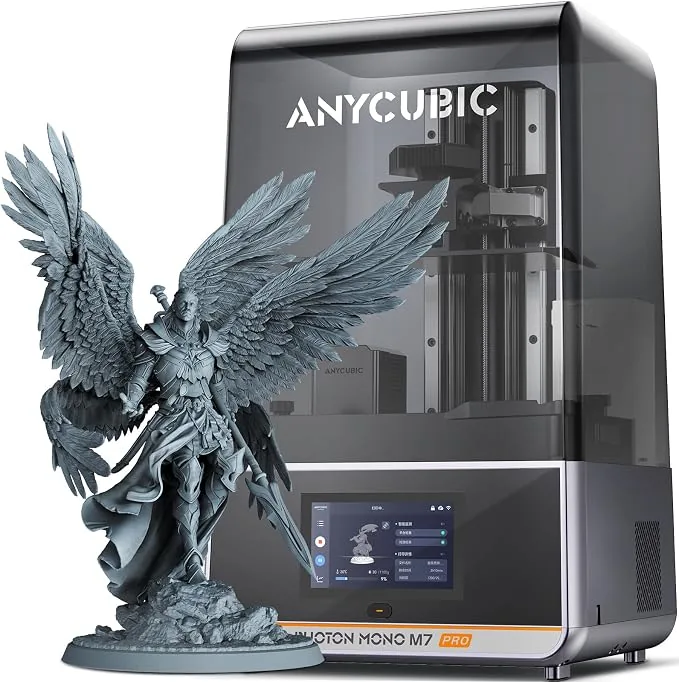
Today, Baba Gee 3D Printing is cutting through the marketing noise to find the absolute best resin printers for your tabletop army. The days of blurry details and visible layer lines on your 28mm hero are over. We are in the era of 12K+ resolution, heated vats, and blazing fast print speeds.
Forget what you knew a few years ago. The technology has leaped forward. A sub-20 micron XY resolution is no longer a dream; it is the new standard for anyone serious about miniature quality. A printer from 2022 is a relic. Your minis deserve better.
This guide is for the hobbyist who needs crisp pauldrons, sharp banner details, and character faces that actually have expression. We will go over the hardware that matters, ignore the specs that do not, and give you our research-based recommendations for 2026.
What Actually Matters: Key Specs for Miniature Printing
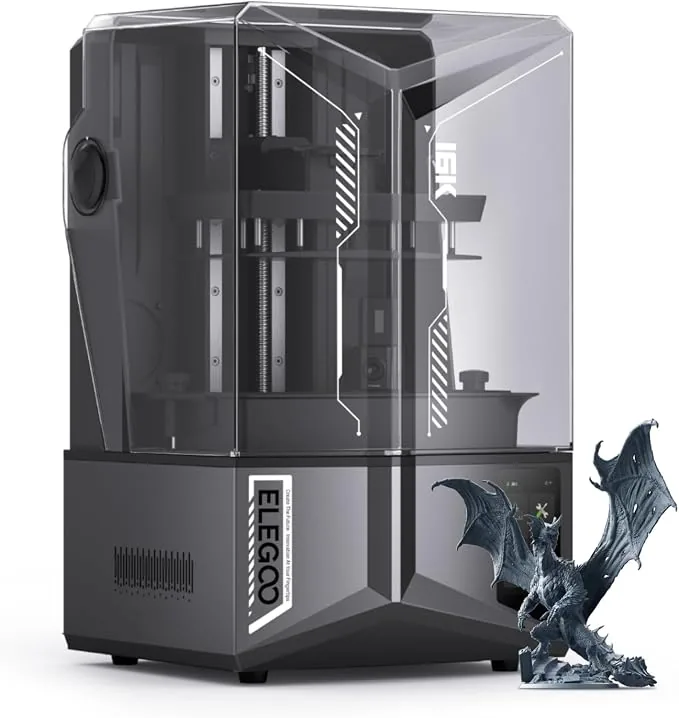
When you are printing a tiny goblin shaman or an ornate space knight, only a few technical specifications make a real, visible difference. Let’s break down the critical hardware.
The Resolution War: Is 14K the New 4K?
Yes. The pixel density of the mono-LCD screen directly defines the XY resolution. This is the smallest dot of light the printer can create, measured in microns (µm).
- 8K Screens: Around 28-35 µm. Good, but the edges can look a little soft on very small details.
- 12K Screens: Around 19-24 µm. This is the sweet spot. Details are incredibly sharp. You can see belt buckles and finger segments clearly.
- 14K Screens: Around 16-20 µm. This is the current cutting edge. The improvement over 12K is noticeable under magnification, especially on fine textures like chainmail or fabric.
A smaller micron number is always better. For miniatures, anything under 25 µm produces professional-grade results. The Z-axis resolution, or layer height, is also important. Most modern printers can easily achieve 0.05mm or even 0.02mm layer heights, which are functionally invisible on a painted model.
Speed Without Failure: ACF Film and Lift Speeds
The biggest bottleneck in resin printing has always been the “peel” force. Each cured layer must be peeled off the FEP film in the bottom of the vat. Do this too fast, and delicate parts like spears, antennae, or claws will get ripped off.
Enter ACF (Advanced Composite Film). This new type of release film has a much lower surface tension than older FEP or nFEP sheets. The practical result? You can dramatically increase lift speeds.
- FEP/nFEP Max Speed: 40-60 mm/min
- ACF Max Speed: 150-400 mm/min
A printer with ACF can finish a plate of miniatures in 1-2 hours instead of 4-6. It is a massive quality-of-life improvement that also reduces print failures by putting less stress on the model.
Workshop-Proof Features: Auto-Leveling and Heated Vats
Printers are getting smarter. Two features once considered luxuries are now essential for reliability.
- Mechanical Auto-Leveling: Forget leveling with a piece of paper. New systems use a mechanical sensor on the build plate arm to measure the distance to the screen at multiple points. The printer then compensates for any slight tilt in firmware. This nearly eliminates first-layer failures and the need for constant re-calibration.
- Heated Vats: Resin viscosity is highly dependent on temperature. In a cold garage or basement (below 20°C / 68°F), resin becomes thick like honey. This causes poor layer adhesion and failed prints. A built-in resin heater or heated vat keeps the resin at an optimal 25-30°C.
Best Resin Printers for Miniatures: 2026 Workshop Picks
After countless hours of printing, cleaning, and calibrating, here are the machines that earn our recommendation.
Editor’s Choice: Anycubic Photon Mono M7 Pro 14K
The M5s Pro is a perfect example of modern resin printing tech. It combines a massive 10.1-inch 14K resolution screen with the practical features you need for consistent, fast output. The heated vat and air purifier module is a fantastic addition, making it a self-contained printing station that tackles the two biggest workshop problems: cold resin and fumes.
Its 16.8 µm XY resolution is staggering. At that resolution, filigree on a sorcerer’s staff can be reproduced even when it is barely visible to the naked eye, yet the detail was perfectly resolved. The auto-leveling system is truly set-it-and-forget-it. After the initial setup, we did not have to touch it again for dozens of prints.
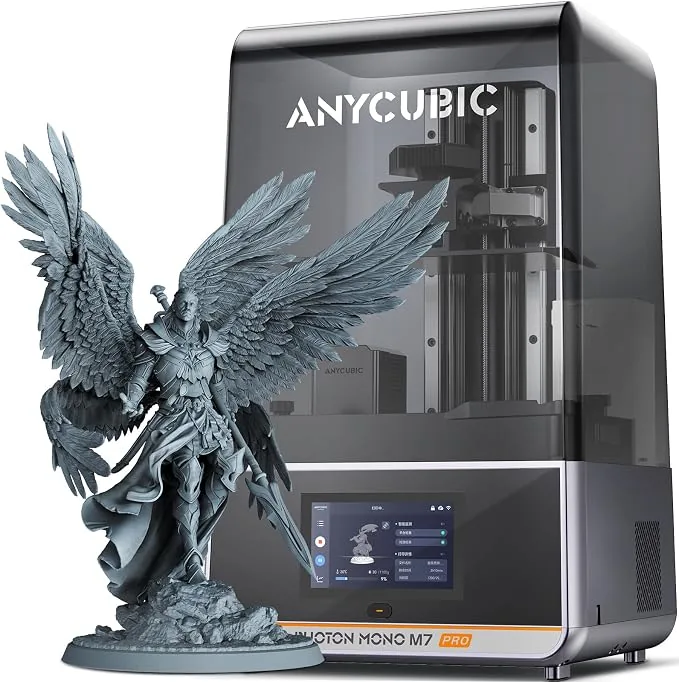
Anycubic Photon Mono M7 Pro 14K Resin 3D Printer
Pros
- Industry-first 14K mono LCD delivers unmatched 16.8x24.8 micron XY precision.
- Dynamic peristaltic resin auto-fill and auto-recycle system eliminates mid-print running out.
- Built-in vat heating element maintains optimal 25°C viscosity in cold workshops.
Cons
- Higher initial price point for hobbyists.
Best Value: Elegoo Mars 4 Ultra
Not everyone needs the absolute best or the biggest build volume. For printing squads of infantry or single characters, the Elegoo Mars 4 Ultra delivers incredible performance for its price. It uses a 7-inch 9K screen, which provides a 18 µm XY resolution. This is even sharper than some larger 12K printers because the pixels are packed into a smaller area.
It includes a fast ACF film right out of the box and uses Elegoo’s new COB+refractive lens light source for excellent uniformity. While it lacks auto-leveling and a heater, its core printing capability is top-tier. If you work in a temperature-controlled room and do not mind a 4-bolt manual level, you can get results that are nearly indistinguishable from more expensive machines. It is a true workhorse.
Specification Showdown: At a Glance
| Feature | Anycubic Photon Mono M5s Pro | Elegoo Mars 4 Ultra |
|---|---|---|
| Screen Resolution | 14K (13312x5120) | 9K (8520x4320) |
| XY Resolution | 16.8 µm | 18 µm |
| Build Volume | 223 x 126 x 200 mm | 153 x 77 x 165 mm |
| Leveling | Automatic (Mechanical) | Manual (4-Point) |
| Heated Vat | Yes | No |
| Release Film | ACF (or similar) | ACF |
| Connectivity | Wi-Fi, USB | Wi-Fi, USB |
| Price Tier | Mid-High | Entry-Mid |
How to Choose Your Miniature Factory
Making the right choice comes down to three factors: budget, environment, and volume.
1. Your Workshop Environment: Do you print in a cold basement or garage? If yes, the heated vat on the Anycubic Photon Mono M5s Pro is not a luxury; it is a necessity. It will save you countless hours of troubleshooting failed prints. If your print space is always above 20°C, a heater is less critical.
2. Your Print Volume: Are you printing single hero models or entire armies? The larger build plate of the M5s Pro allows you to print a full squad of 10-15 models at once. The Elegoo Mars 4 Ultra is better suited for smaller batches or single, large monsters.
3. Your Budget and Time: The Mars 4 Ultra offers insane detail for the money. If you are on a tighter budget and have the patience for manual leveling, it is the clear winner for pure print quality per dollar. The M5s Pro costs more, but you are paying for convenience, reliability, and speed that gets your army on the table faster.
For more information on selecting the right material for these machines, explore our guides on 3D printing filament guides. Getting the right resin is just as important as the printer itself.
Best Resin 3D Printers by Use Case, Workflow and Safety Requirements
Understanding your specific requirements helps in selecting the ideal machine for your projects. Dive into the complete overview of Best Resin 3D Printers by Use Case, Workflow and Safety Requirements.
Final Calibrations
The gap between hobbyist and professional-grade miniatures has closed. With printers like the Anycubic Photon Mono M5s Pro and Elegoo Mars 4 Ultra, you can achieve detail that rivals or even exceeds traditionally manufactured models. Focus on the core specs: sub-20 micron XY resolution, ACF film for speed, and smart features like heating and auto-leveling that match your workshop needs.
Pick the right tool, dial in your exposure settings, and you will be pulling flawless models off the build plate every time. Happy printing. To see more top models for different applications, view all our recommended Resin 3D Printers.